A Ground-Level Guide to Reading a Sports Court
Reading a sports court before play helps you spot its surface, markings, fittings and shared spaces, so you can orient yourself and move with care.
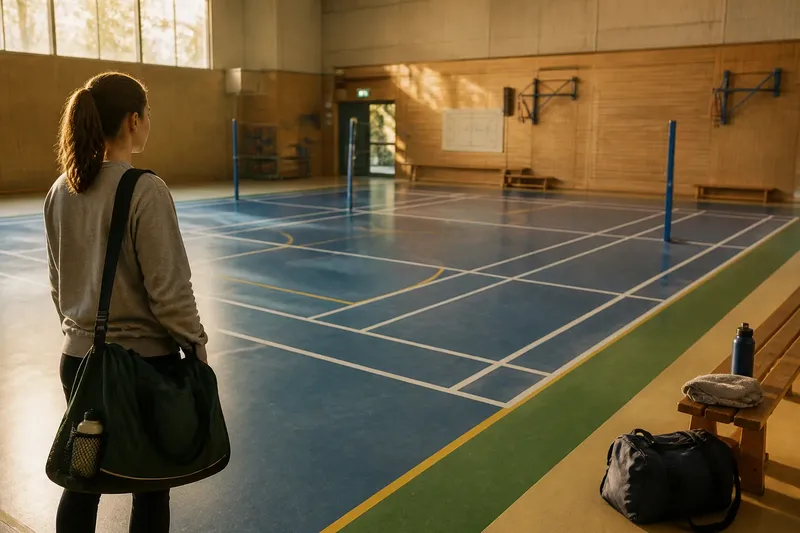
You arrive at an unfamiliar court while another group is packing up. Before stepping on, reading a sports court begins with simple clues: the surface underfoot, the lines crossing it, the fittings at its edges and the space around it. Together, these details show how the venue is arranged and where play, waiting and movement are likely to happen.
Let the surface tell you where you are
Start with the ground rather than the signs. A smooth, sealed surface may suit quick changes of direction, while a textured coating can offer a different feel underfoot. Timber boards, artificial turf and compacted outdoor surfaces each have their own appearance and sound. Look for changes in colour, texture or finish; a court may combine a playing area with a distinct border or adjoining walkway.
Notice whether the surface appears continuous or divided into panels. On an indoor court, seams between boards or tiles can help explain the playing area’s orientation. Outdoors, a change in material may mark the edge of the court without a fence or kerb. These are observations, not a substitute for venue instructions: if the surface looks wet, loose or damaged, ask staff before using it.
Also look at the slope and drainage around an outdoor court. A gentle fall towards a drain can explain why water collects away from the playing space. Avoid treating a drain cover, access ramp or uneven border as part of the court, even if its colour resembles the playing surface.
Follow the markings as a system
A court can carry several sets of lines, often in contrasting colours. Rather than guessing from one boundary, trace a complete shape and see which markings belong together. A rectangle with a centre line and service areas suggests one arrangement; a second, narrower rectangle may indicate that another sport is also accommodated. The colour alone does not settle the question, since venues choose different schemes.
Look for repeated features: matching line widths, paired boxes, arcs, centre marks or clearly separated end zones. These can help distinguish a main layout from overlays for another activity. A sign at the entrance or a court diagram is the better guide to the intended game, particularly where several sports share the same floor.
Check how the lines meet the edges. If a marking runs beneath a movable net or ends near a post, it may define a playing boundary only when that fitting is in place. Don’t assume every visible line applies to the game you have come to play; ask your group or the venue which layout is in use.
Read the fixed fittings before you move
Posts, sockets, hoops, anchors and wall-mounted equipment reveal how the court can be configured. Some fittings are permanent, while others are inserted or adjusted for a particular session. An empty socket can look like a small detail, but it may sit within a playing area or along a route where people walk.
Scan the edges for storage points and controls. A wall bracket may hold a net when it is not in use; a marked sleeve in the floor may receive a post. Notice whether equipment is already set up and whether unused fittings are covered. Do not adjust an unfamiliar mechanism or lift a heavy fitting simply to identify it. Ask the responsible staff member to explain it.
Say you arrive at a shared indoor court with blue and white rectangles and two net posts resting in wall brackets. You trace the blue lines and see that they form one complete court, while the white lines make a second layout across it. If the venue’s board lists a session using the blue layout, you can orient yourself without treating the white lines as extra boundaries.
Notice the space beyond the playing area
The court does not end at its boundary line in practical terms. Look for the run-off space between the line and a wall, fence, bench or neighbouring court. A generous clear area gives players room to slow down; a narrow strip may mean that movement needs more attention. Keep bags, bottles and spare equipment outside the playing area and away from doorways.
Pay attention to how people enter and leave. An entrance behind a baseline, a shared gate between courts or a route crossing the side of the playing area can affect when it is sensible to walk across. Watch for other users collecting balls or changing equipment, and wait until the space is clear rather than stepping through an active exchange.
Lighting, windows and overhead structures matter too. Glare from a bright window may make one end harder to see from, while low beams or suspended fittings can limit the space above the court. A quick look up and towards each end helps you spot these features before play starts.
What should you check before play?
How can you identify the main court layout?
Trace one set of markings into a complete, coherent shape, then compare it with a posted diagram or booking information. If several layouts overlap, confirm which one the session is using before treating any line as a boundary.
Are all the visible fittings meant to be used?
No. A socket, bracket or folded post can belong to a different configuration or be out of service. Leave unfamiliar fittings alone and ask venue staff which equipment is intended for the session.
Where should you leave bags and bottles?
Use a bench or storage area outside the marked playing space and clear of entrances, walkways and the space around posts. If the venue has a designated storage spot, follow its arrangement rather than choosing a convenient corner.
What if the surface or boundary looks unclear?
Pause and ask the person responsible for the court instead of inferring the answer from colour or appearance. A quick clarification can prevent confusion about the active layout or an area that should remain clear.
Build a useful first impression
Reading a sports court is a matter of connecting visible clues: surface changes, complete line patterns, fixed fittings and the room left around play. A small circuit around the edge can answer practical questions about orientation and access before anyone starts moving quickly.
Keep that first look modest. You are not expected to identify every marking or piece of equipment at once; focus on the active layout, any obstacles and the route people use to enter. If something remains uncertain, a venue diagram or staff member is more useful than a confident guess. That habit makes reading a sports court a practical way to arrive prepared while leaving the space organised for everyone sharing it.